

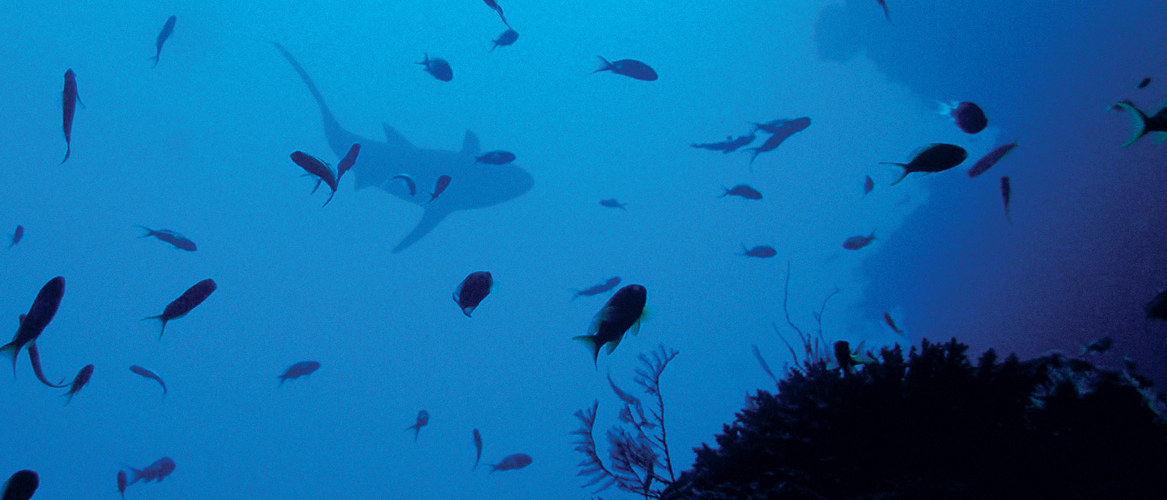
Reef shark tagging
Vamizi initiated a program to capture Grey Reef Sharks using a single gangion (to minimize stress to the animal) to introduce visual tags (to the side of the main dorsal fin) and acoustic tags (through a surgical procedure). The Research Centre is now able to record the presence of individual sharks. This has provided data on individual shark residency periods at the site and has been cross-validated against acoustic tag data.
At the Neptune’s Arm dive site, a large aggregation of up to 30 Grey Reef Sharks has been witnessed at certain times of the year. All the sharks are mature females, suggesting that this location may be very important in the sharks’ reproduction cycle. There has been a decline in numbers over the life of this project, but there are still many grey reef sharks present.
Vamizi’s aggregation is one of very few known along the East African Coast, where shark populations are severely threatened. Consequently, it is important to fully understand the behaviour of the Grey Reef Shark.
So far, three pregnant females have been fitted with acoustic tags, one of which also has a satellite tag attached to the dorsal fin. Results show that these sharks spend a lot more time at Neptune’s than we initially suspected, with most of their time at an average of 20m, though deeper dives have been recorded when water temperature increases.
Contrary to previous understanding, this newly enabled research shows that these sharks spend a lot of time near the surface, putting them at further risk of being removed through fishing. For this reason, it is very important to collect more data from more individuals, as well as work on protective measures to make sure this population (and as a consequence, many other species) remains protected. Further shark research is under way focusing on hammer head sharks as well as grey reefsharks.